
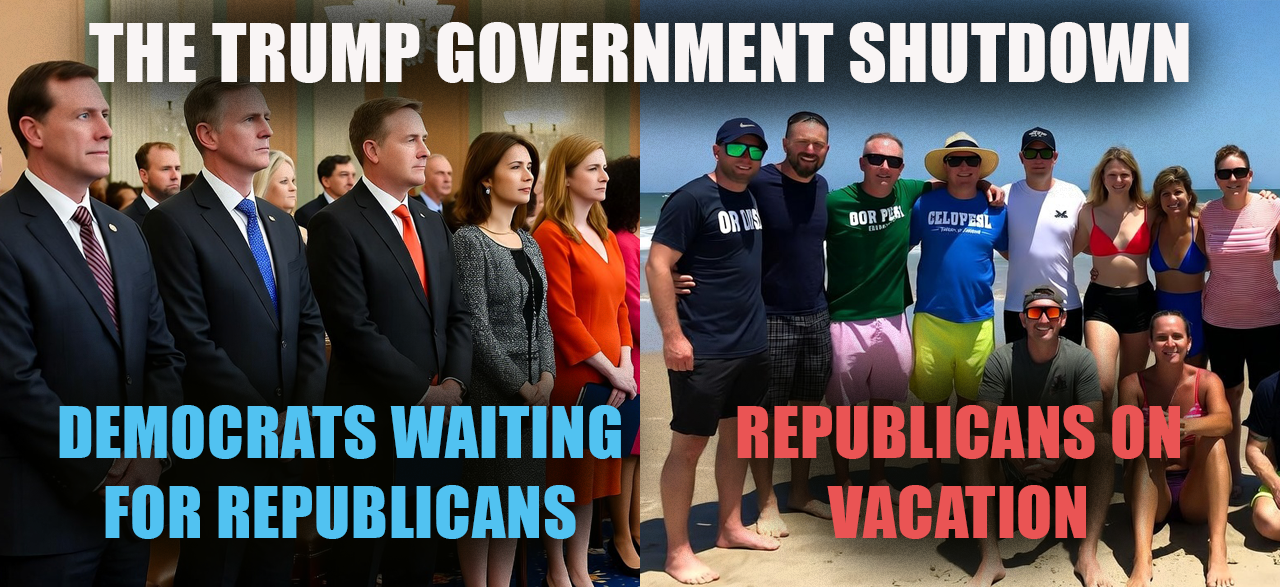
Saying Democrats are entirely responsible for the recent government shutdown ignores that Republicans controlled the House and the president (Trump) was issuing directives and Republicans provided the initial spending proposal, which was bloating the deficit and giving billionaires huge tax cuts on the backs of the working and middle classes.
The Republicans set the terms of the continuing resolution that the Senate debated. The administration also took actions that added to the deadlock, including deploying messaging blaming Democrats, canceling meetings, and instructing agencies to prepare reduction-in-force plans which many analysts argue escalated the standoff.
The core dispute that led to the shutdown involved funding legislation + policy riders (i.e., the ACA subsidy extension). Democrats wanted the funding bill to include those subsidies; Republicans did not—and insisted on a funding vehicle without them.
That policy disagreement prevented the funding bill from passing. Because Republicans controlled the House and the president, they had substantial control over the legislative agenda. So attributing the shutdown exclusively to Democrats omits the role of the Republican-led side in crafting the bill and negotiation strategy.
Speaker Johnson sent lawmakers home roughly three weeks ago after passage of a funding bill and announced that the House would not return to session. The House had remained out of regular legislative session during the ongoing partial government shutdown, meaning there has been little to no floor business so Congress was not “working” in the sense of normal operations and advancing legislation.
The Speaker has the power to call the House into session, schedule votes and manage the legislative calendar. Johnson’s decision to keep Congress from meeting was based on Trump wanting to attack federal government and to not allow the #EpsteinTrumpFiles from being released.
The federal government shutdown began on October 1, 2025 when funding lapsed. During the shutdown, the House did not hold regular floor business or votes for many weeks.
The Republican-led House stayed in recess during the entirety of the shutdown and has not held any votes. Speaker Johnson ordered the House to not meet in its usual legislative session for most of the shutdown period (about seven weeks), meaning the chamber was largely inactive on the floor.
Here’s what the so-called “One Big Beautiful Bill Act” (often referred to as the “Big Beautiful Bill”) does with respect to veterans’ benefits, Supplemental Nutrition Assistance Program (SNAP) food assistance and the Federal Aviation Administration (FAA) / federal workforce. The bill includes large cuts to the federal funding for SNAP. According to experts, it would reduce federal nutrition funding by about $186 billion between 2025-2034.
Veterans & others may lose eligibility or face delays; states face higher costs… Veterans (and military families) especially in transition may face greater obstacles. For instance, the veterans-family site noted that “many aren’t able to qualify for SNAP because BAH (basic allowance for housing) is included in eligibility calculations” and that “cuts to the program will force states to tighten their eligibility requirements.”
Longer wait times; reduced service capacity for veterans… The Veterans Administration is reportedly planning to reduce its workforce by about 80,000 jobs (about 15% of its workforce). These cuts could seriously impact veterans’ access to healthcare, claims processing, mental health services (including for toxic exposure or burn pits) and other benefits. The FAA has terminated a large number of employees (about 400+) with some of the terminations including maintenance mechanics, aviation safety assistants and other roles that support safety oversight. The aerospace and aviation sectors will face staffing stresses if supporting roles are eliminated or reduced.
Potential safety concerns; staffing pressures…
Blaming Democrats for that IS FUCKING INSANE.