
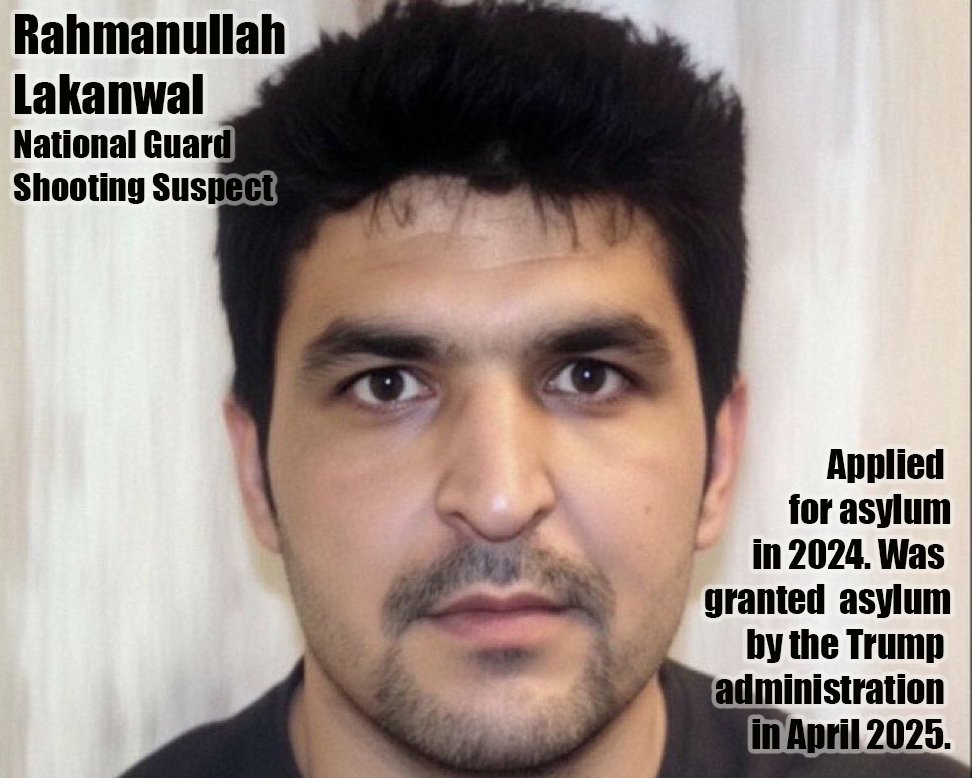
We keep hearing from Homeland Security leadership that Afghans are being let in by the thousands without any vetting whatsoever. It’s a lie.
Several recent news reports state that the suspect in the November 26, 2025 Washington, D.C. shooting — identified as Rahmanullah Lakanwal — “was granted asylum in April 2025 under the Donald Trump administration.”
According to those reports, Lakanwal “applied for asylum in December 2024” and was approved in April 2025. He is identified in U.S. military and immigration-related reporting as an Afghan interpreter who supported American troops, especially during the height of the war in Afghanistan. Interpreters like him were essential to nearly all U.S. operations involving local populations, tribal elders, Afghan forces and civil–military engagement.
Trump signed the February 29, 2020 Doha Agreement with a deal directly with the Taliban, excluding the Afghan government. He surrendered Afghanistan to the Taliban.
The Doha Agreement (also called the U.S.–Taliban deal) was signed February 29, 2020. It laid out a timetable for full withdrawal of U.S. troops from Afghanistan in exchange for Taliban commitments: e.g., that the Taliban would stop attacks on U.S./coalition forces and prevent Afghan soil from harboring international terrorist groups.
It was when Trump surrendered Afghanistan to the Taliban, releasing thousands of Taliban prisoners and abandoning the U.S. weapons that had been deployed there. The U.S. war in Afghanistan ended with what generals call a “strategic failure,” and the collapse of the Afghan state… precisely the scenario they had warned Congress about.
After the withdrawal, the bipartisan Special Immigrant Visa (SIV) Program was set up as a U.S. immigration program created to protect Iraqi and Afghan allies who worked for the U.S. government or military and later faced threats from the Taliban because of that service.
The program has long been seen as a moral obligation to wartime allies, not a partisan immigration issue. It was the United States’ promise to protect Afghans and Iraqis who risked their lives helping U.S. forces by giving them a visa, a green card and a safe place to rebuild their lives.
Many applicants were killed by the Taliban while waiting for the SIV process to verify them.
The SIV applicant process undergoes multiple database searches and biometric screening where applicants must go through various steps:
- Identity verification
- Known or suspected terrorist watchlists
- Biometric matching (fingerprints, iris scan, facial recognition)
- Criminal history (U.S. and international sources)
- Military intelligence reporting from Afghanistan or Iraq
- Local partner-nation security info if available
- All previous visa/immigration history
- Social-network, phone, and travel-pattern analysis (if data exists)
- Letters from American supervisors
- Proof of at least 1 year of qualified service
- Evidence of having received threats due to service
Fraud detection teams check for forged letters or false supervisor claims. Applicants must provide:
- Fingerprints
- Photograph
- Iris scans (for many Afghan applicants—DoD collected them on bases) These are compared against:
- U.S. criminal databases
- DoD biometric databases (from battlefields and checkpoints)
- Terrorism-detainee biometrics
INTERPOL and international partners Agencies conducting checks:
- FBI – criminal history & biometric comparison
- CIA – intelligence and counterterrorism databases
- NSA – communications and signals intelligence cross-checks
- DHS/ICE/CBP – immigration databases
- Department of Defense – military debrief centers
- National Counterterrorism Center (NCTC) – terrorism identities database (TIDE)
State Department – Consular Lookout and Support System (CLASS) Before they get to travel to the U.S, SIV applicants must have:
- Another round of biometric checks
- Medical screening
- Travel-document inspection
DHS clearance for entry (“pre-vetting”) Remember why the SIV was implemented:
The U.S. owes protection to Afghans and Iraqis who served with U.S. forces.