
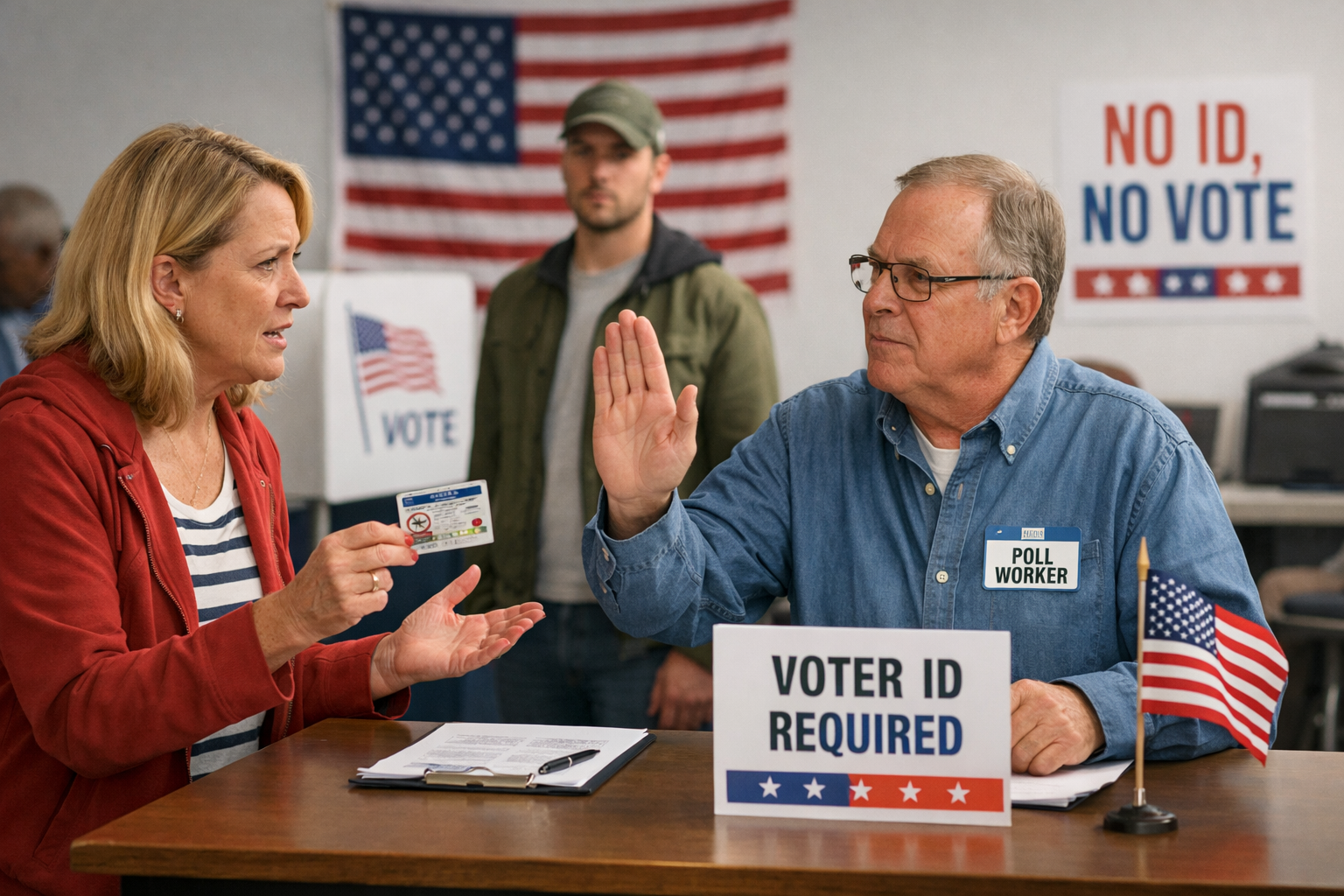
Republicans who want to pass the #SaveAmericaAct haven’t bothered to check that Republican-voting states would be greatly affected if the Act is passed. Their intent to try to stop an non-issue would backfire.
Under the proposed SAVE America Act (also called the Safeguard American Voter Eligibility Act), voters would have to provide documentary proof of U.S. citizenship to register for federal elections and show a qualifying photo ID when voting.
Many common forms of ID would not qualify by themselves because they do not prove citizenship.
IDs That Would Likely NOT Be Accepted Alone:
Standard Driver’s Licenses
Most state driver’s licenses do not show citizenship status or birthplace. Under the bill, a license without citizenship information would not be enough by itself to prove eligibility.
REAL ID Cards
Even REAL ID–compliant licenses often only prove lawful presence, not citizenship. Because non-citizens can obtain REAL IDs, they typically would not qualify alone unless the card explicitly indicates U.S. citizenship.
Military ID Cards
A U.S. military ID normally does not show citizenship status. The bill would require additional documentation (such as a birth certificate) if citizenship is not listed.
Tribal IDs or Other Government Photo IDs (without citizenship info)
Government-issued IDs that do not indicate birthplace or citizenship would also require supporting documents.
Student IDs
College or university IDs would not qualify as proof of citizenship.
Social Security Cards
A Social Security card does not prove citizenship, so it would not be acceptable by itself.
Analyses of the SAVE America Act / SAVE Act suggest several groups of Americans could have more difficulty meeting the new proof-of-citizenship documentation requirement (passport, birth certificate, or similar documents). Research cited by election experts estimates about 21 million U.S. citizens lack ready access to those documents:
Married Women Who Changed Their Last Name
Birth certificates often list maiden names, not current legal names. If the names don’t match exactly, additional paperwork (marriage certificates, etc.) may be required. Analysts say millions of women could face extra steps because of this mismatch.
Nearly 69 million American women who changed their last name through marriage don’t have a birth certificate with their current legal name on it.
Younger Voters
Younger Americans are less likely to have passports or easy access to official documents. Many rely on driver’s licenses or student IDs, which do not prove citizenship under the bill.
Lower-Income Americans
Passports and replacement birth certificates can cost money and require time off work. Studies show lower-income citizens are less likely to own passports.
Native American and Alaska Native Voters
Some tribal members live in remote areas far from election offices. The requirement for in-person registration with citizenship documents could require traveling long distances.
Rural Residents
Rural voters often rely on mail-in or online voter registration, which the bill could limit or eliminate. Traveling to election offices to present documents can be harder in rural areas.
Elderly Voters
Older Americans may not have easy access to birth certificates or may have lost them. Mobility issues can make in-person registration requirements more difficult.
People with Disabilities or Health Issues
In-person documentation requirements can be difficult for people who cannot easily travel to government offices.
Naturalized Citizens
They may need to provide naturalization papers, which can be expensive and time-consuming to replace if lost.
Researchers estimate about 9% of voting-age citizens (~21 million people) lack immediate access to proof-of-citizenship documents like passports or birth certificates.
About half of Americans do not have a passport, one of the main documents that would satisfy the requirement.
States (red) with the lowest passport ownerships:
– West Virginia
– Kentucky
– Mississippi
– Alabama
– Arkansas
– Louisiana
– Oklahoma
– Kansas
– South Dakota
States (blue) with the highest passport ownerships:
– New Jersey
– Massachusetts
– New York
– Connecticut
– California
– Washington
– Oregon
The SAVE Act would disproportionately affect rural voters, seniors, veterans, married women, naturalized citizens, veterans, students and low-income citizens as well as those who lost records due to natural disasters and other property losses.
Millions of eligible citizens don’t have the required documents readily available — for example, many don’t own passports, and others (such as married women whose names changed) might have documents that don’t match their current names.
The Save Act is voter suppression acting as a trojan horse voter fraud reduction effort, where voter fraud is seen as a problem, where it is actually extremely rare.
The Heritage Foundation maintains a database of proven voter fraud cases since 1979. As of recent counts, this included about 1,465 confirmed cases over ~44 years — an average of fewer than 35 per year. Most did not affect election outcomes.
A 2016 Washington Post review found only 4 documented voter fraud cases in that presidential election out of 136 million votes cast — an extremely low number relative to total turnout.
A database compiled by News21 covering 2000–2012 identified about 2,068 alleged voter fraud cases out of hundreds of millions of votes cast, which translates to roughly 0.000003 alleged cases per vote cast.
Voter fraud, after dozens of investigations, is about 0.006%, which is equal to someone winning the Lottery on the same day they were struck by lightning.