
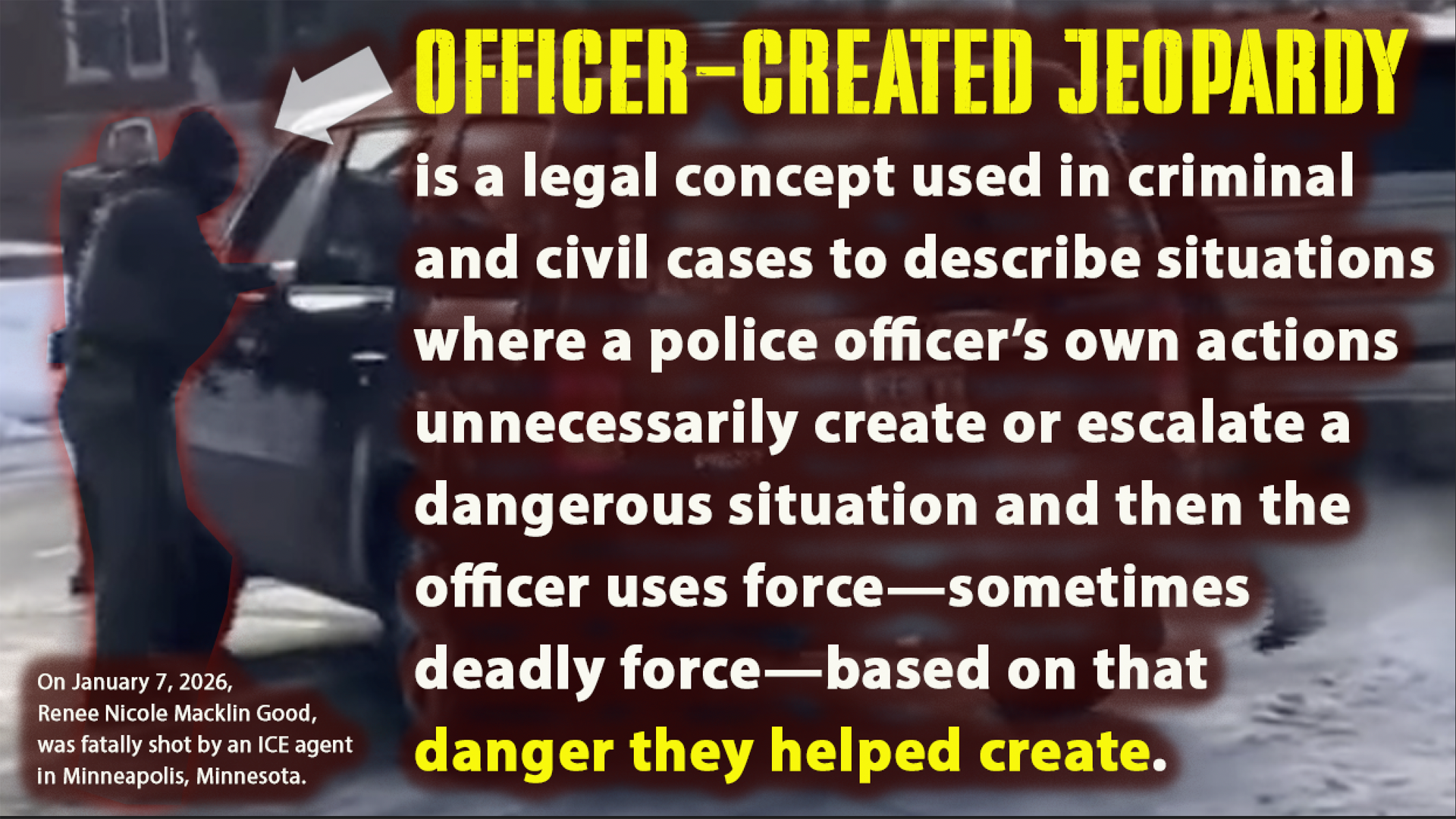
#OfficerCreatedJeopardy should go viral with the murder of Renee Good by ICE.
On January 7, 2026, #ReneeNicoleGood, a 37-year-old US citizen, was fatally shot by United States Immigration and Customs Enforcement (#ICE) agent Jonathan Ross in Minneapolis, Minnesota.
Officer-created jeopardy is a legal concept used in criminal and civil cases to describe situations where a police officer’s own actions unnecessarily create or escalate a dangerous situation and then the officer uses force—sometimes deadly force—based on that danger they helped create.
If an officer unreasonably creates a crisis through their tactics, decisions, or commands, they may be held responsible for the resulting danger and cannot always justify force by pointing to that danger.
Officer-created jeopardy means police cannot justify violent force by pointing to a danger that their own unreasonable actions helped create.
In policing and legal analysis, officer-created jeopardy refers to situations where an officer’s own tactical decisions or positioning unnecessarily increase risk to themselves or others, escalating a confrontation and making a violent outcome more likely. An officer may be found to have created jeopardy if they place themselves in a dangerous position without justification, fail to de-escalate, or otherwise provoke conditions that lead to deadly force being used.
- Federal officials have claimed the ICE agent shot the driver in self-defense as her vehicle moved toward him.
- Independent experts and local officials have questioned that narrative, noting video appears to show the vehicle not posing an immediate lethal threat and the officer’s positioning/response may not align with established best practices for use of force.
- A use-of-force expert said aspects of the agent’s conduct “violated police tactics,” suggesting he was not in immediate danger and that shooting at a moving vehicle under these conditions diverged from accepted practice.
- Witnesses also reported a militarized scene where ICE agents prevented bystanders from aiding the woman after she was shot, adding to concerns about escalation.
If an officer positions himself in front of a vehicle, fails to retreat or seek cover when a car moves, or otherwise engages in unnecessary risk that contributes to the need for force, critics might argue that constitutes officer-created jeopardy — i.e., the officer’s own tactics helped create the dangerous situation. Under that view, tactics that place the officer in harm’s way and escalate risk could undermine a self-defense claim.